When do customers chat with businesses?
We studied 17,000+ AI chat conversations at 16 businesses: 56% start outside business hours, replies take 6 seconds, and 6 in 100 go to a person.
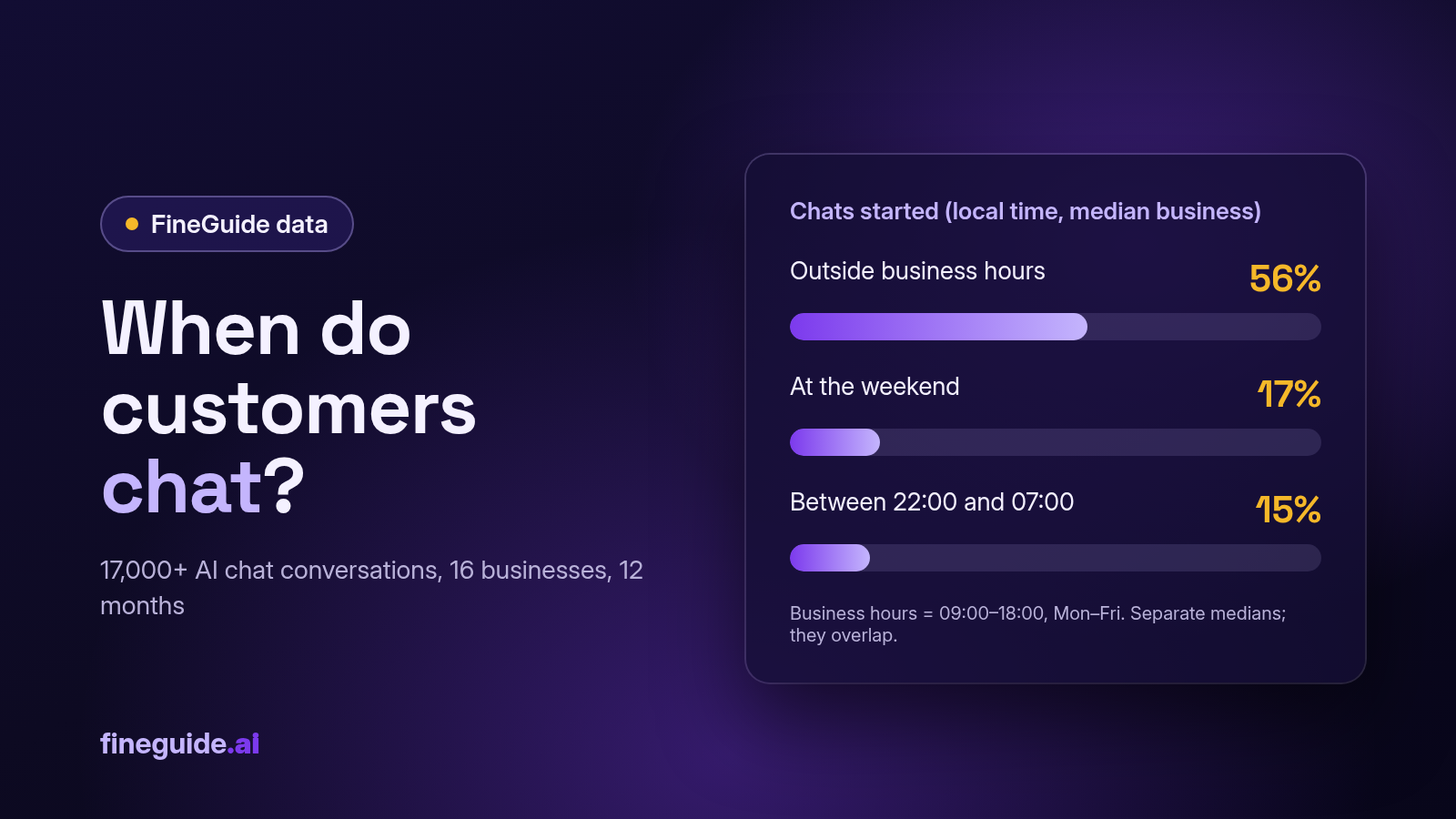
At the typical business in our data, more than half of customer chats (56%) start outside business hours: before 9:00, after 18:00 or at the weekend. We measured this across 17,000+ AI chat conversations at 16 businesses over 12 months. Customers also expect a fast answer: the AI’s first reply came in a median of 6 seconds, and 4 in 10 chats were a single question.
Below is what the numbers show, how we counted them, and what a small team can do with them.
When do customers start chatting?
Most businesses staff their chat from 9 to 6, Monday to Friday. Their customers don’t keep those hours.
| When the chat started (local time) | Share of chats at the typical business |
|---|---|
| Outside business hours (before 9:00, after 18:00, or weekend) | 56% (half of businesses: 53–63%) |
| On a Saturday or Sunday | 17% |
| Between 22:00 and 07:00 | 15% |
The three rows are separate medians, so they overlap and don’t add up to 100%. The first row is the headline: in more than half of the businesses we looked at, most chats arrived when nobody was at work.
A normal day shows why. Someone compares prices on the sofa at 21:30. A parent asks about a course after the children are asleep. A shop owner checks delivery times on Sunday morning. None of them will call; all of them will type a question into a chat window if one is there.
How fast do customers expect an answer?
Fast. Across the businesses, the assistant’s first reply arrived in a median of 6 seconds, and even the slower replies (the 90th percentile) came in about 11 seconds.
That speed matters because most chats are short:
- 4 in 10 conversations had exactly one customer message. The customer asked, got an answer, and left.
- The typical conversation had 2 customer messages.
- Fewer than 1 in 5 conversations reached five or more customer messages.
A website chat is usually one question. If the first answer is wrong, vague or late, there is often no second chance.
How often does a person still need to step in?
Less often than many teams expect, but it never drops to zero.
Among the businesses whose assistant records handoffs, a median of 6 in 100 conversations (between 5 and 10 for half of them) ended with the assistant handing the customer to a person. In FineGuide that happens when the visitor asks for a person or when one of your rules says so, and it respects your team’s business hours. We wrote about choosing those rules in when your AI should pass the chat to a person.
Among the businesses whose assistant asks for contact details, a median of 5% of conversations ended with the customer leaving a phone number or e-mail, and up to 16% at the more sales-focused ones. Those details go straight into the contact in the CRM, with the chat attached.
So the work splits cleanly. The assistant answers the many short questions at any hour. People take the few conversations that need judgement, with the whole history in front of them in the shared team inbox.
What should a small team do with this?
- Cover evenings and weekends. That is where more than half of the chats are. An AI assistant on your website chat answers them at 21:30 and on Sunday morning, from your own information.
- Make the first answer count. Train the assistant on your own website pages, documents and written answers, and use the “only answer from what it learned” mode where accuracy matters most. Then test it with ten real customer questions. Our guide to training a chatbot on your documents shows how.
- Plan the handoff. Decide when the assistant passes a conversation to a person (the customer asks, or a rule says so) and who picks it up the next morning.
- Ask for contact details only where it makes sense: a quote, a booking, a callback. Asking in every chat slows down the 4 in 10 people who only had one question.
- Watch your own numbers. The conversation analytics show how your assistant performs, how satisfied customers are and what they ask about. Compare your chats with the medians above.
How did we count?
- Period: 1 December 2025 to 26 November 2026 (UTC).
- Who: businesses using FineGuide’s AI assistants. Our own and test accounts were excluded.
- What a conversation is: a chat session with at least one customer message. Empty widget openings don’t count.
- Equal weight per business: every number was first computed for each business (businesses with at least 20 conversations), then we took the median across businesses. One very busy business can’t skew the result this way.
- Local time: for the time-of-day numbers we used the business’s country to convert to local time (11 businesses with a known country). Business hours are 09:00 to 18:00, Monday to Friday.
- Handoff and contact figures come only from businesses whose assistant records those fields (6 and 8 businesses).
- Privacy: counts only. No message text was read, no customer or business is named, and no figure comes from fewer than five businesses.
- Limits: these are small and mid-size businesses in Europe and the Americas, in different industries. It is a snapshot of FineGuide customers, not of every company.
FAQ
Do customers really chat at night?
Yes. At the typical business in our data, 15% of chats started between 22:00 and 07:00 local time, and 17% at the weekend.
How quickly should a website chat reply?
Within seconds. The AI assistants in our data replied in a median of 6 seconds, and most chats were over after one or two customer messages, so a slow first reply often means a lost question.
Will an AI assistant replace my support team?
No. In our data about 6 in 100 conversations still went to a person. The assistant takes the routine questions at any hour; your team takes the ones that need a human, during its working hours.
Can I see these numbers for my own business?
Partly. The conversation analytics in FineGuide show how your assistant performs, customer satisfaction, sentiment and the intents people ask about, so you can see where your chats differ from these medians.
If you want your evening and weekend chats answered from your own information, you can start with an AI assistant on your website in a few minutes.
Last checked: 27 November 2026 against the product.